Prompt Engineering
Prompt engineering is the practice of designing and optimizing the instructions given to an AI model to get reliable, high-quality outputs. It is the craft of communicating effectively with LLMs — structuring inputs so the model produces the response you need.
What is prompt engineering?
LLMs are general-purpose text processors — they generate the most likely continuation of whatever input you provide. Prompt engineering is the discipline of designing that input to reliably get the output you want. Small changes in how a prompt is worded can produce dramatically different outputs: more accurate, more concise, better structured, or more aligned with your requirements.
At its most basic, prompt engineering involves writing clear instructions. At its most sophisticated, it involves techniques like chain-of-thought prompting, few-shot examples, role assignment, output format specification, and systematic evaluation of prompt variants.
Key prompt engineering techniques
Few-shot prompting: include examples of the input-output pairs you want in the prompt itself. Instead of explaining what a good output looks like, show the model three examples. This dramatically improves output consistency for structured tasks.
Chain-of-thought prompting: ask the model to 'think step by step' before giving its final answer. This technique improves performance on reasoning tasks by forcing the model to articulate intermediate steps rather than jumping to a conclusion.
Role and context setting: tell the model who it is and what the context is before asking your question. 'You are a senior lawyer reviewing a commercial contract. Identify any clauses that create unusual liability exposure.' The role frames the model's interpretation of every subsequent instruction.
Output format specification: explicitly define the format you need. 'Respond in JSON with the following fields.' 'Use bullet points.' 'Maximum 3 sentences.' Format specification prevents the model from choosing a structure that doesn't work for your downstream use case.
Prompt engineering vs. fine-tuning
Prompt engineering modifies the input; fine-tuning modifies the model. For most enterprise use cases, prompt engineering should come first — it's fast, free, and often sufficient. Fine-tuning is warranted when you need the model to behave in ways that can't be reliably achieved through prompting alone, or when you need to reduce token costs by shortening prompts.
Enterprise context
Why this concept matters
In enterprise AI projects, clear definitions prevent teams from buying or deploying the wrong thing. The same term can mean a product feature, a technical pattern, or an operating model. Wonka uses this glossary to connect concepts back to real workflows, private data, governance, and measurable adoption.
When evaluating this topic, look at the systems involved, the data boundaries, the human approval points, and whether the workflow can be repeated safely across teams.
The practical question is not only what the concept means, but how it changes day-to-day work. A useful enterprise AI pattern should help teams retrieve trusted context, keep evidence visible, and turn repeated requests into workflows that administrators can monitor.
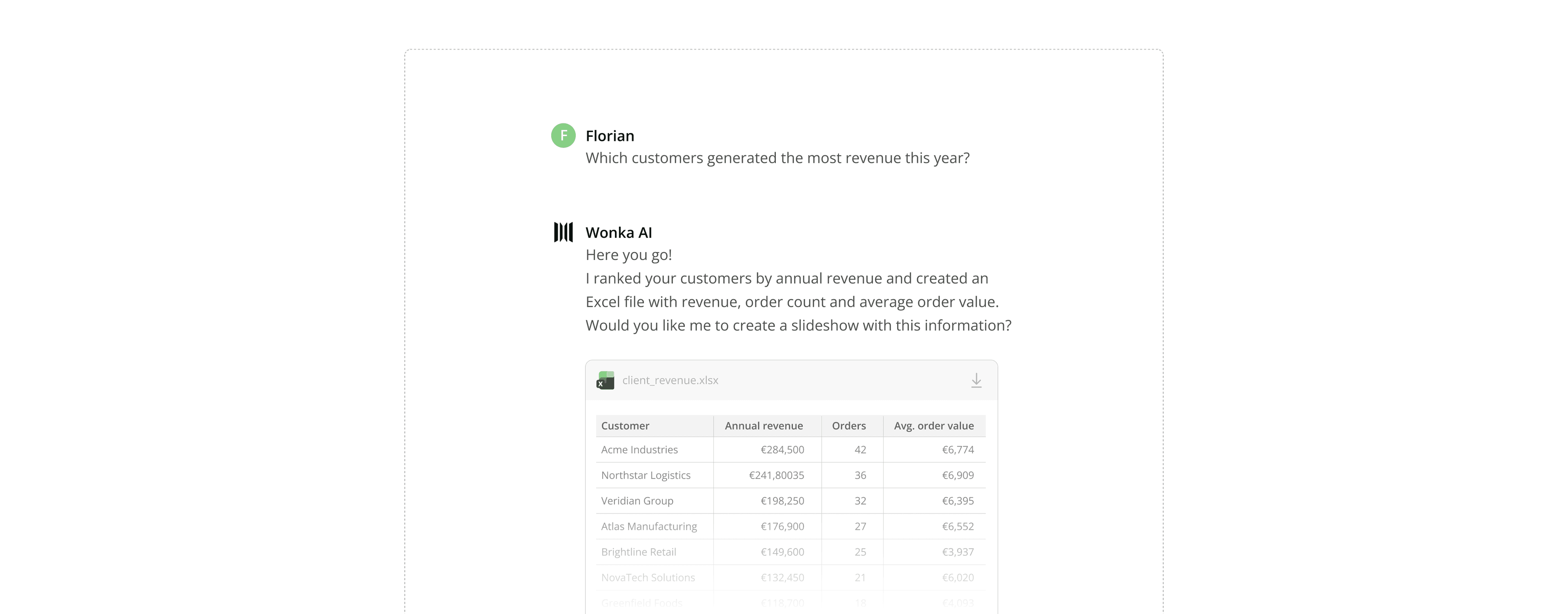
From question to spreadsheet
Ask for the numbers and get a working file back: WonkaChat reads your data sources and builds the report your team would have spent hours on.
Go further
Frequently asked questions
Is prompt engineering still relevant with modern models?
Yes, but the techniques have evolved. Newer models (Claude 3.5, GPT-4o) are less sensitive to exact phrasing and more capable of inferring intent from natural language. However, structured prompting — format specification, few-shot examples, chain-of-thought — still substantially improves output quality and consistency on complex tasks.
What is a system prompt?
A system prompt is an instruction given to the model before the user's message, typically by the application developer. It sets the model's role, constraints, and behavior for the entire conversation. In enterprise AI deployments, system prompts define the AI's persona, access scope, output format, and safety guardrails.
How do you evaluate whether a prompt is good?
Systematically: define what 'good output' looks like for your task, create a test set of representative inputs, run the prompt against the test set, and score the outputs. Gut feel is not sufficient for production prompts. A/B testing prompt variants against a scored test set is the standard approach.
Explore related AI topics

Private enterprise AI with GDPR built in.
Wonka AI connects private AI agents to your existing tools and data. Hosted in Azure West Europe (Microsoft Ireland) by default, with GDPR compliance, access control and audit logs included.
Book a demo- Connects to your full stack: SharePoint, Salesforce, Slack, Jira and more
- Azure West Europe hosting, GDPR compliant, ISO 27001 certified
- Deployed in weeks, not months

Your team is too good for this work.
Let's find out where Wonka AI can make a difference.
Book a 30 min call