On-premise (On-prem)
On-premise refers to software and infrastructure that is installed and runs on servers physically located within an organization's own facilities — as opposed to cloud-based solutions hosted by a third-party provider. For AI deployments, on-premise means the model runs on hardware you own and control.
What does on-premise mean?
On-premise (often abbreviated 'on-prem') describes a deployment model where software runs on hardware that the organization owns or leases and physically controls. The servers are in your data center, your office, or a co-location facility you manage — not in a cloud provider's infrastructure.
The opposite of on-premise is cloud-hosted or SaaS: the software runs on servers owned by a vendor (AWS, Microsoft Azure, Google Cloud, or the software vendor itself), and you access it over the internet. Most modern enterprise software has shifted to cloud delivery, but on-premise remains the standard in regulated industries, high-security environments, and organizations with strict data sovereignty requirements.
On-premise AI: what it means in practice
For enterprise AI, on-premise deployment means the LLM itself — the model weights and the inference infrastructure — runs on servers within your environment. When an employee asks a question, the query goes to your server, the model processes it on your hardware, and the response is returned — nothing touches a cloud provider's infrastructure.
True on-premise AI requires significant hardware investment: GPU servers for model inference, storage for document indexing, networking for low-latency access. A 70B parameter model in 4-bit quantization needs approximately 40GB of GPU VRAM, meaning multiple high-end GPU servers for a production deployment.
On-premise vs. private cloud
On-premise means hardware you physically own and operate. Private cloud means a dedicated cloud environment you control — either in a public cloud provider's infrastructure (your own VPC on AWS or Azure) or in a co-location facility — but the hardware is not managed by you. Both approaches achieve data sovereignty; the difference is who manages the underlying hardware.
For most enterprises, private cloud deployment offers a practical middle ground: full data sovereignty without the capital expense and operational complexity of owning GPU servers. Wonka AI supports both on-premise and private cloud deployment depending on your infrastructure requirements.
Enterprise context
Why this concept matters
In enterprise AI projects, clear definitions prevent teams from buying or deploying the wrong thing. The same term can mean a product feature, a technical pattern, or an operating model. Wonka uses this glossary to connect concepts back to real workflows, private data, governance, and measurable adoption.
When evaluating this topic, look at the systems involved, the data boundaries, the human approval points, and whether the workflow can be repeated safely across teams.
The practical question is not only what the concept means, but how it changes day-to-day work. A useful enterprise AI pattern should help teams retrieve trusted context, keep evidence visible, and turn repeated requests into workflows that administrators can monitor.
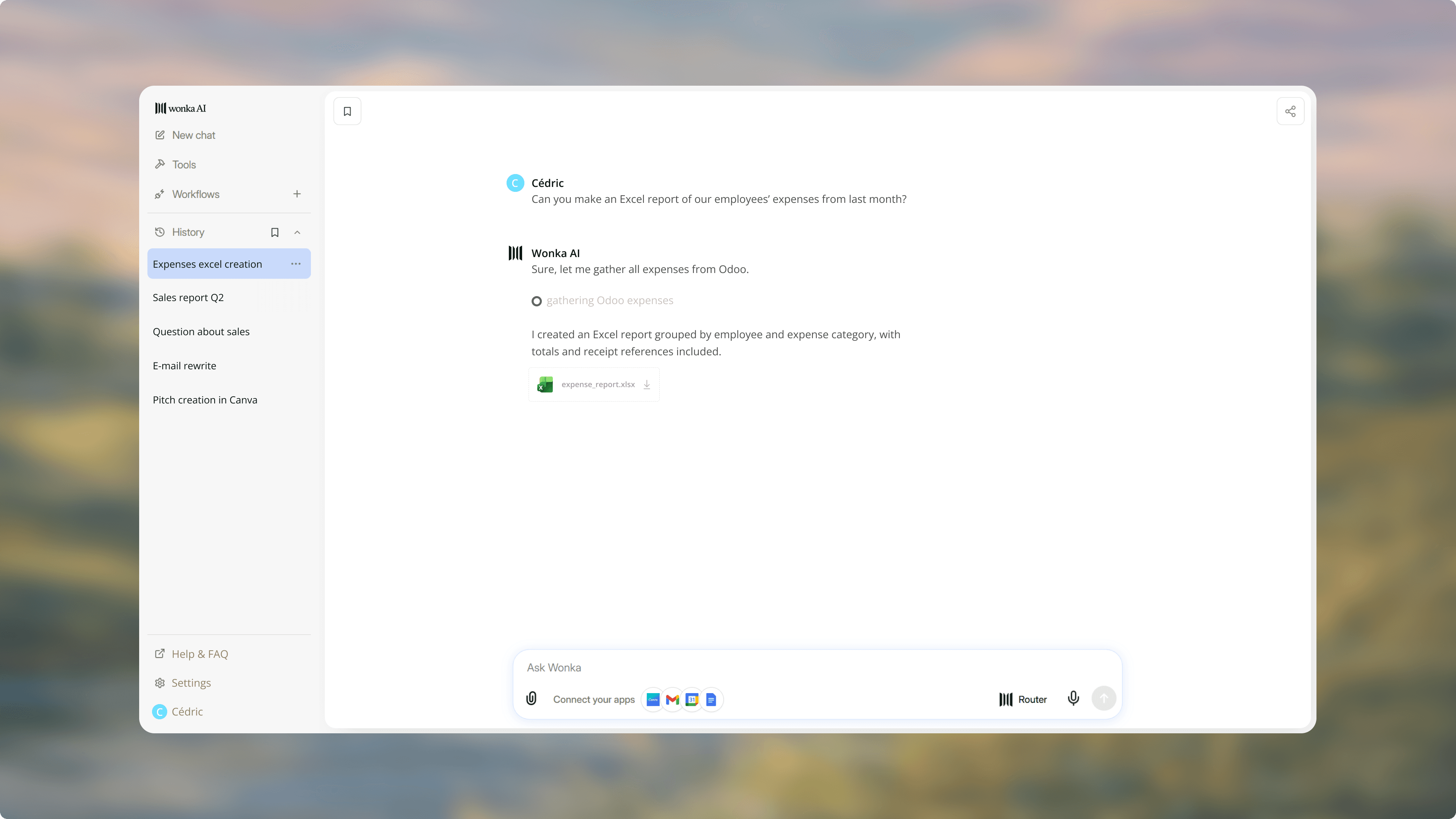
Governed AI for everyone
Approved models, permissions by team, EU hosting and admin controls: the rules of your AI policy, applied by the tool.
Go further
Frequently asked questions
Is on-premise AI more secure than cloud AI?
It can be, but security depends more on how you configure and manage the environment than where it runs. A poorly secured on-premise server is less safe than a well-configured private cloud environment. On-premise gives you full control; what matters is whether you exercise that control effectively.
What are the main disadvantages of on-premise AI?
Capital cost (GPU servers are expensive), operational complexity (you manage hardware, software updates, and reliability), scaling constraints (adding capacity requires hardware procurement), and slower access to model improvements (you update models manually rather than automatically).
Can on-premise AI connect to cloud services?
Yes, selectively. An on-premise AI can call external APIs for non-sensitive operations while keeping sensitive data processing local. The architecture question is: which data leaves your environment and which stays? For most regulated enterprises, the model inference and document processing must stay on-premise, while non-sensitive API calls (sending a calendar invite, looking up a public data source) can go to the cloud.
Explore related AI topics

Private enterprise AI with GDPR built in.
Wonka AI connects private AI agents to your existing tools and data. Hosted in Azure West Europe (Microsoft Ireland) by default, with GDPR compliance, access control and audit logs included.
Book a demo- Connects to your full stack: SharePoint, Salesforce, Slack, Jira and more
- Azure West Europe hosting, GDPR compliant, ISO 27001 certified
- Deployed in weeks, not months

Your team is too good for this work.
Let's find out where Wonka AI can make a difference.
Book a 30 min call