MCP (Model Context Protocol)
MCP is an open standard developed by Anthropic that allows AI models to connect securely to external tools, data sources, and services. It gives LLMs a standardized way to read files, query databases, call APIs, and take actions — without custom integration code for each tool.
What is MCP?
Model Context Protocol (MCP) is an open protocol introduced by Anthropic in 2024 that standardizes how AI models interact with the outside world. Before MCP, connecting an LLM to a tool — a database, a file system, a web service — required custom integration code for every combination. MCP defines a universal interface: any tool that implements the protocol can be used by any model that supports it.
Think of MCP as the USB standard for AI. Just as USB lets any device connect to any computer without custom hardware, MCP lets any tool connect to any AI model without custom code. This dramatically reduces the engineering effort required to build AI-powered workflows.
How MCP works
An MCP server is a small program that exposes a set of capabilities — called 'tools' — to an AI model. A tool might be 'read a file', 'query a database', 'send an email', or 'search Salesforce contacts'. The AI model can call these tools during a conversation to get information or take actions.
The protocol handles authentication, input/output formatting, and error handling in a standardized way. From the model's perspective, every MCP server looks the same — it declares what it can do, the model calls what it needs, and the result comes back in a predictable format.
Why MCP matters for enterprise AI
Enterprise AI is only useful when it can access the data and tools your team actually uses. MCP makes this practical. Instead of building a custom integration for every tool in your stack, you deploy MCP servers — one per tool — and any AI in your environment can use all of them immediately.
Wonka AI uses MCP to connect to your existing tool stack: SharePoint, Salesforce, Jira, Slack, Notion, and more. When you add a new tool, you add an MCP server. The AI gains access to it without any changes to the core system. This is how enterprise AI scales across a heterogeneous tool environment.
Enterprise context
Why this concept matters
In enterprise AI projects, clear definitions prevent teams from buying or deploying the wrong thing. The same term can mean a product feature, a technical pattern, or an operating model. Wonka uses this glossary to connect concepts back to real workflows, private data, governance, and measurable adoption.
When evaluating this topic, look at the systems involved, the data boundaries, the human approval points, and whether the workflow can be repeated safely across teams.
The practical question is not only what the concept means, but how it changes day-to-day work. A useful enterprise AI pattern should help teams retrieve trusted context, keep evidence visible, and turn repeated requests into workflows that administrators can monitor.
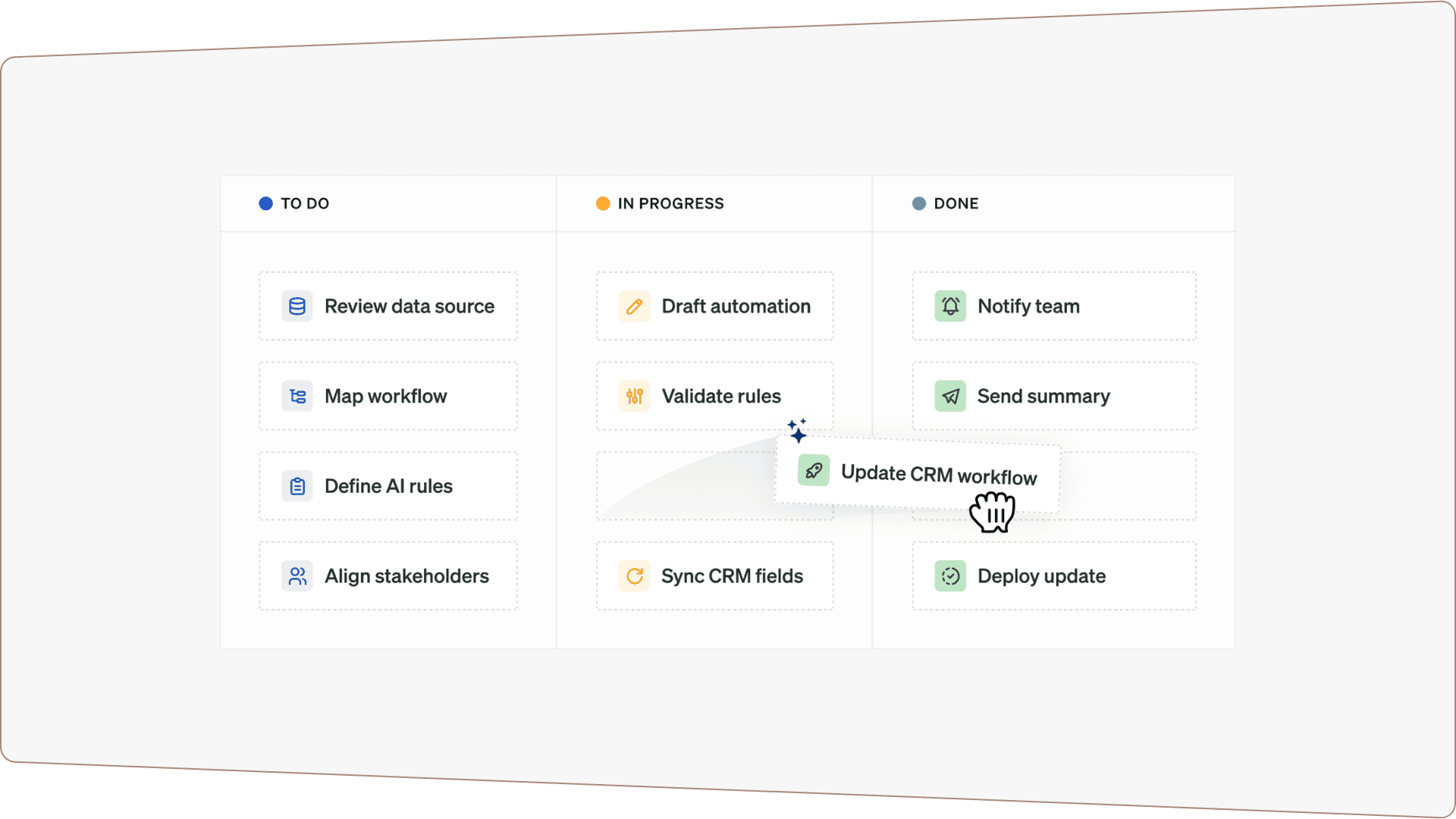
Agents that finish the job
In WonkaChat, teams create agents for specific tasks, connect them to their tools and keep a human in the loop for every action that matters.
Go further
Frequently asked questions
Who created MCP and is it open source?
MCP was created by Anthropic and released as an open standard in November 2024. The specification and reference implementations are open source. It is designed to be model-agnostic — any LLM can implement MCP support, not just Anthropic's Claude.
What is the difference between MCP and a standard API?
A standard API is a fixed interface to one specific service. MCP is a meta-protocol: it defines how AI models discover and call any tool, regardless of what that tool does. An MCP server wraps an existing API and exposes it in a way the AI model can understand and use autonomously.
Is MCP secure for enterprise use?
MCP includes authentication and authorization mechanisms. In an enterprise deployment, MCP servers run within your private infrastructure — they never expose your tools to the public internet. Each server's permissions are explicitly defined, so the AI can only do what you have authorized.
Explore related AI topics

Private enterprise AI with GDPR built in.
Wonka AI connects private AI agents to your existing tools and data. Hosted in Azure West Europe (Microsoft Ireland) by default, with GDPR compliance, access control and audit logs included.
Book a demo- Connects to your full stack: SharePoint, Salesforce, Slack, Jira and more
- Azure West Europe hosting, GDPR compliant, ISO 27001 certified
- Deployed in weeks, not months

Your team is too good for this work.
Let's find out where Wonka AI can make a difference.
Book a 30 min call