AI Agent
An AI agent is an AI system that can take sequences of actions autonomously to accomplish a goal — not just respond to a single prompt, but plan, use tools, check results, and iterate until the task is complete.
AI agent
AI agent matters because enterprise AI only becomes useful when it is connected to real data, real permissions and real workflows. A definition is helpful, but teams also need to know where the concept creates value and where it creates risk.
Why it matters
In practice, teams use AI agent to decide how much autonomy an AI system should have, which tools it can access, what evidence it should provide and when a human should approve the next step.
How teams use it
- Summarize internal knowledge with the right sources.
- Prepare actions in CRM, ERP or project tools.
- Automate repetitive tasks without losing human control.
- Help teams make decisions with more context.
Enterprise checklist
The most important design choice is scope. A narrow workflow with clear inputs is easier to secure, measure and improve than a broad assistant that tries to answer every question in the company.
- Does the workflow have a clear owner?
- Are the data sources approved and limited?
- Do users know when to approve or correct the answer?
- Is performance measured with business criteria?
Security and governance
A second design choice is governance. Access control, audit logs, escalation rules and quality checks should be designed before the first production deployment, not after users discover edge cases.
Where Wonka fits
Wonka is built for companies that want private AI agents connected to real business tools such as SharePoint, Odoo, Salesforce, Slack and Microsoft 365. The goal is not another chatbot tab. The goal is a controlled AI layer that can understand company context, respect permissions and help teams complete work faster.
How to prove quality before rollout
Before a team relies on the workflow, test it against real examples from the business. Include easy cases, ambiguous cases and cases where the correct answer is to stop and ask a human. This creates a practical benchmark that the team can reuse after every prompt, model or integration change.
- Test answers on real business examples.
- Keep sources and approvals inside the workflow.
Enterprise context
Why this concept matters
In enterprise AI projects, clear definitions prevent teams from buying or deploying the wrong thing. The same term can mean a product feature, a technical pattern, or an operating model. Wonka uses this glossary to connect concepts back to real workflows, private data, governance, and measurable adoption.
When evaluating this topic, look at the systems involved, the data boundaries, the human approval points, and whether the workflow can be repeated safely across teams.
The practical question is not only what the concept means, but how it changes day-to-day work. A useful enterprise AI pattern should help teams retrieve trusted context, keep evidence visible, and turn repeated requests into workflows that administrators can monitor.
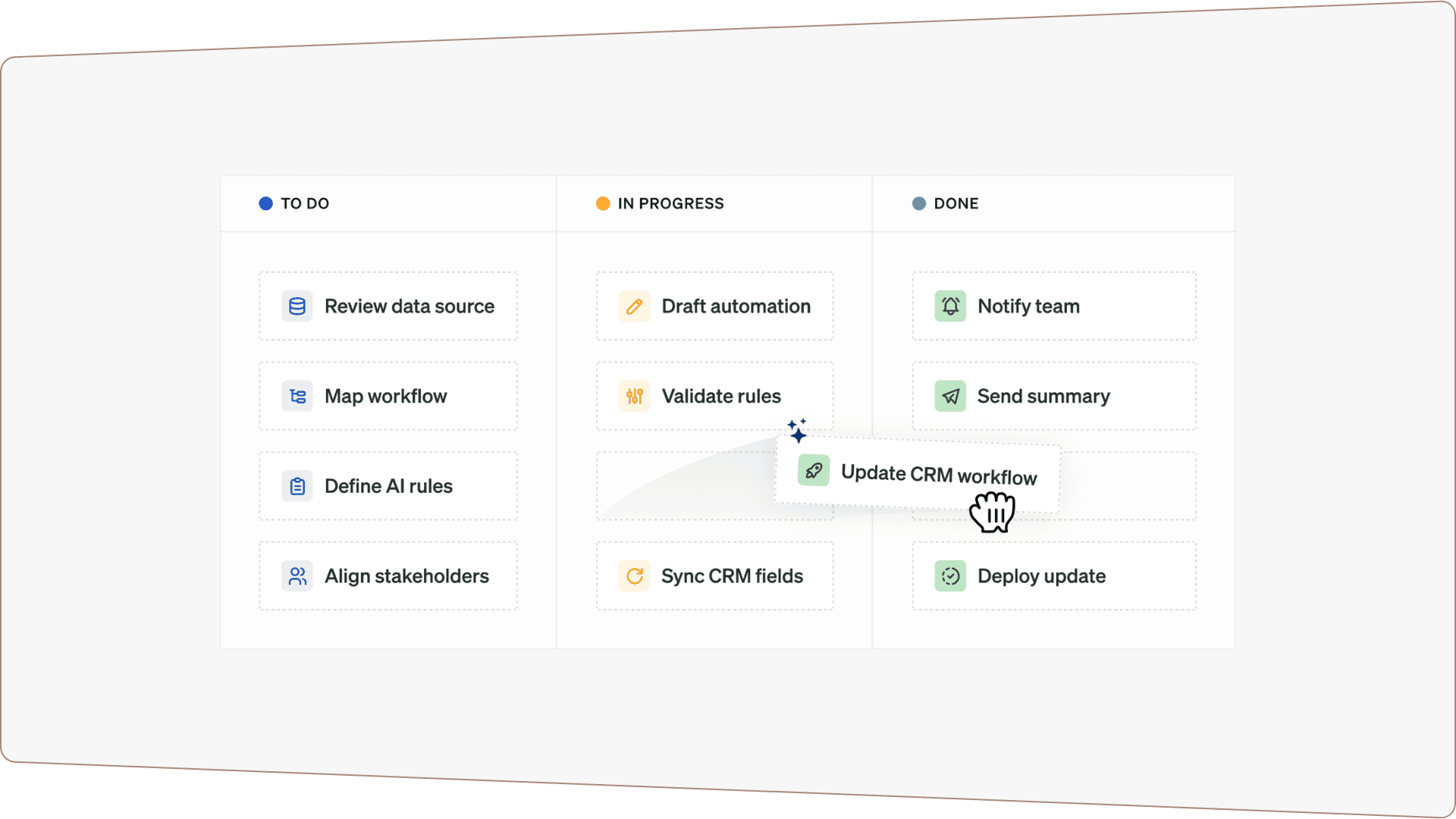
Agents that finish the job
In WonkaChat, teams create agents for specific tasks, connect them to their tools and keep a human in the loop for every action that matters.
Go further
Frequently asked questions
Why does this matter for enterprise AI?
It helps teams move from generic AI answers to governed workflows that use approved data, tools and review steps.
Can Wonka support this kind of workflow?
Yes. Wonka is designed for private AI agents connected to business systems with controlled access and governance.
Related articles
Related integrations
Explore related AI topics

Private enterprise AI with GDPR built in.
Wonka AI connects private AI agents to your existing tools and data. Hosted in Azure West Europe (Microsoft Ireland) by default, with GDPR compliance, access control and audit logs included.
Book a demo- Connects to your full stack: SharePoint, Salesforce, Slack, Jira and more
- Azure West Europe hosting, GDPR compliant, ISO 27001 certified
- Deployed in weeks, not months

Your team is too good for this work.
Let's find out where Wonka AI can make a difference.
Book a 30 min call